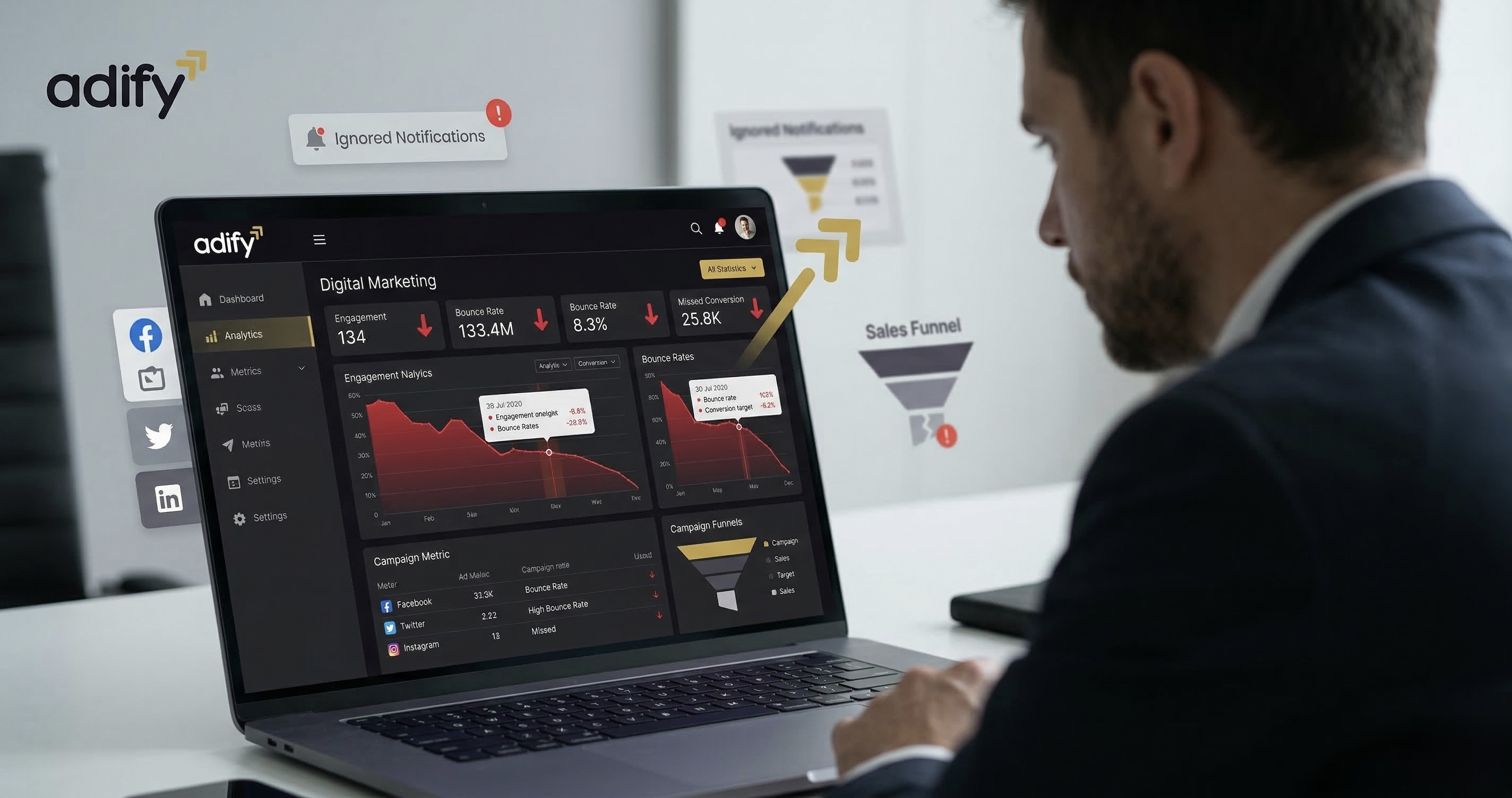
A funnel is not a marketing buzzword. It is a map of your customer's journey from stranger to buyer — and knowing that map changes everything about how you spend your marketing budget.
What Most Business Owners Get Wrong
When we audit a new client's marketing, the most common pattern we find is a bottom-of-funnel obsession. Every campaign is built to convert. Every piece of content ends with a hard sell. Every ad is "Book Now" or "Get a Quote."
This approach has a ceiling. You are only speaking to the tiny percentage of your market that is ready to buy right now. Research from the Ehrenberg-Bass Institute suggests that at any given moment, only 5% of your target market is actively in-market. The other 95% are your future customers — and traditional conversion-focused campaigns are completely invisible to them.
The Three Stages That Actually Drive Growth
Stage 1: Awareness (Top of Funnel)
At this stage, your goal is not to sell. It is to be seen by the right people and to create a memorable first impression. Content marketing, short-form video, Meta awareness campaigns, and PR all live here. The metric that matters is reach among your target audience and brand recall.
Brands that consistently invest in awareness campaigns find that their bottom-of-funnel conversion rates improve over time because people are arriving pre-warmed. They already know your name. The trust groundwork was laid weeks or months earlier.
Stage 2: Consideration (Middle of Funnel)
Now the prospect knows you exist. The question is whether they trust you enough to engage. This is where most businesses have the biggest gap. There is no bridge between "I've seen this brand" and "I'm ready to buy."
The middle funnel is built from case studies, comparison content, email sequences, webinars, and retargeting campaigns that educate rather than push. Every piece of content here should answer the question your prospect is privately asking: "Is this right for me?"
Stage 3: Conversion (Bottom of Funnel)
By the time a properly nurtured prospect reaches this stage, conversion is often the natural next step. They have consumed your content. They have seen your proof. They understand your offer. Now a direct, benefit-focused campaign lands on fertile ground instead of cold scepticism.
Our data across client accounts consistently shows that prospects who have been through a proper top and middle funnel convert at 3–6x the rate of cold traffic — and at a significantly lower cost per acquisition.
Building Your Funnel: A Practical Starting Point
You do not need a complex multi-channel system to start. Begin with three things:
One awareness asset: A weekly short-form video, a blog post, or a simple organic social series that educates your target audience on a topic related to your service.
One consideration asset: A lead magnet — a guide, a checklist, a mini-audit — that gives genuine value in exchange for an email address. This moves someone from passive observer to active prospect.
One conversion mechanism: A clear, specific offer with a dedicated landing page and a follow-up email sequence. Not your homepage. A page built for one decision.
The Compounding Effect
Here is what makes funnel-based marketing genuinely powerful: each stage feeds the next, and the system gets stronger over time. Every piece of awareness content you publish adds to your retargeting pool. Every lead magnet download adds to your email list. Every email you send warms a future sale.
Businesses that invest in this infrastructure for 12 months find themselves in a position where their cost per acquisition is falling while their lead volume is rising. That is the compounding effect of a properly built funnel — and it is the closest thing to a sustainable competitive advantage in digital marketing.